“When Jesus saw the crowds, he had compassion on them, because they were harassed and helpless, like sheep without a shepherd” (Matt 9:36). Compassion without action is just a feeling—not very useful. The dynamic of our Lord Jesus is always to move from emotion to action. From the beginning of his ministry, his program was a program of action: “The Spirit of the Lord is upon me, because he has anointed me to proclaim good news to the poor. He has sent me to proclaim freedom for the captives and recovery of sight for the blind, to set the oppressed free, and to proclaim the year of the Lord’s favor.” (Luke 4:18-19). The Church has always stood with the vulnerable and the little ones. But at some point, these vulnerable and little ones, once aware of their situation, will have to take matters into their own hands using nonviolent means that respect the dignity of every human being.”
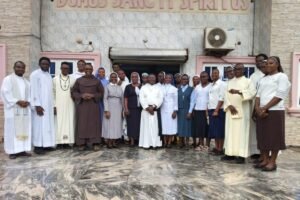
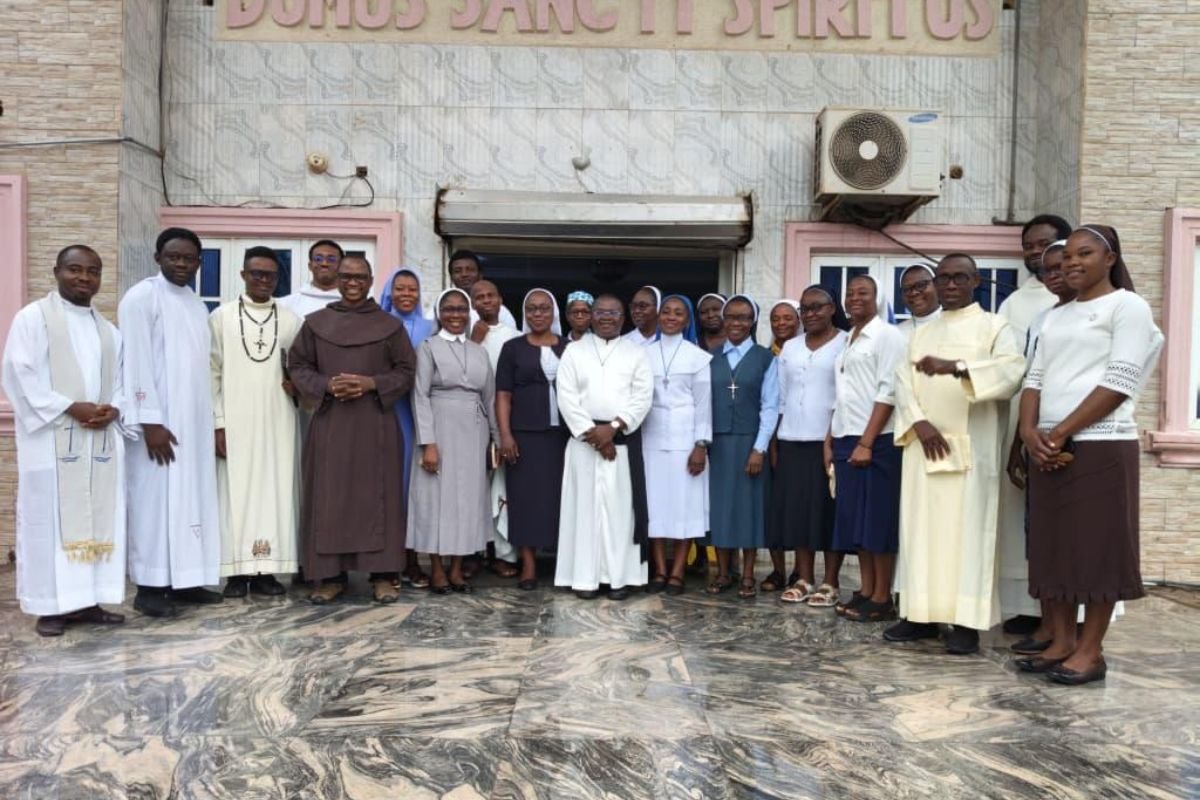
With the upcoming elections next year in Nigeria, questions arise: why vote? Whom to vote for? How to make sure the results reflect the votes? The Justice and Peace Initiative (JPI) of religious in Nigeria (Platform of The Association of the Major Superiors in Nigeria) wanted to respond in advance by preparing some possible solutions. The goal is to train and mobilize Catholic faithful and people of goodwill to engage in the patriotic process as a duty. That’s why, during our Annual General Meeting which took place from the 14th to 17th of October 2026, at the Domus Sancti Spiritus Guest House in Enugu (Nigeria), we chose to discuss the theme as an action plan: “From apathy to hopeful action: empowering Nigerians for the 2027 elections to demand integrity and accountability in leadership”.
This initiative is not an isolated commitment, but has a doctrinal foundation in the Catholic faith, “It is in full conformity with human nature that there should be juridico-political structures providing all citizens in an ever better fashion and without any discrimination the practical possibility of freely and actively taking part in the establishment of the juridical foundations of the political community and in the direction of public affairs, in fixing the terms of reference of the various public bodies and in the election of political leaders. All citizens, therefore, should be mindful of the right and also the duty to use their free vote to further the common good.” (Cf. Second Vatican Council, Pastoral Constitution Gaudium et Spes, no. 75). And the Nigerian Episcopal Conference had already made an appeal to all Catholic faithful and people of good will in the previous elections in these terms: “Our votes are precious; we must use them wisely. We encourage all eligible citizens to go out in large numbers to vote for leaders who fear God, are honest, dynamic, and transparent for a better Nigeria.” And in their communication from the last plenary held at Ede in Osogbo Diocese (10-18 September 2026), the Nigerian Bishops encouraged everyone to be relevant in these upcoming elections in these words : “As we approach the 2027 General Elections, we call on all stakeholders to work for free, fair and credible elections. We encourage eligible voters to come out en masse to vote qualified people into offices and in line with their good consciences. As a Conference, we have issued a pastoral letter regarding the forthcoming general elections. We call on all citizens to study the pastoral letter and follow the provisions and guidelines. We invite all dioceses and parishes in our nation to embark on civic education, mobilization and end-of-month fasting and prayer with Rosary processions from October to December 2026 in preparation for the elections. We announce that 8 December 2026 will be observed as special and national day for prayer and fasting for the success of the elections”. The Church, indeed, has not only something to say but also it has something to do.
It is with this perspective that our platform took certain initiatives, including sessions on elections, and our efforts to actively engage people in getting involved before, during, and after the elections. This training mainly targets young leaders who, in turn, can pass the message on to youth groups and other parishioners in parishes and other places of apostolate.
Of course, a transparent process can give hope to trustworthy and credible leadership. That’s why, through our humble participation, our platform aims to be an alarm in this post-election period to wake up those among us who complain about bad governance without actually participating in improvement or change, those who are crushed by past experiences and have lost hope; those who see elections as a feature-length movie whose outcome is already known in advance and remain motionless.
Of course, change cannot happen in the blink of an eye, but change is prepared. It is prepared when Nigerians will continue to more and more take democratic actions demanding accountability. But how do you demand accountability from the leaders if you are not actively engaged in the democratic process. In his article “Our Distress Democracy” Rev. Fr. Anthony Akinwale lamenting the fact that country democracy is not being based on the people, says: “The relationship between government and citizen is simply master/servant relationship in which government is more powerful than the people, and in which officials of government see themselves as lords and the citizen as slaves. Public servants see themselves as benefactors of the citizens. If and when they do what they are hired to do, they posture as people doing you favour” (From the Independent No. 28520 Sund. 26th July 2026, P. 4).
This contradiction in democratic practice continues when no one reminds these leaders that they were employed by the people and for the people, and that they must be accountable, not the other way around. It’s through smart, coordinated, and continuous engagement by all citizens that the foundations of integrity are built. Yet, demands for accountability from leaders must be backed by legal structures ready to protect everyone’s rights. It’s also where the strongest call should go to civic elites working on organizing elections, so they prioritize truth and justice or, at the very least, listen to their conscience.
Looking at what happens in Africa during elections, we are convinced that the truth is always strong, but like water that takes the colour of the container that holds it, people believe that the truth sometimes takes the form of those who speak it. That’s why we have terms like: “Démocratie à l’africaine|” African-style democracy”. Ofcourse, those who know the truth either do not want or do not know how to speak about it; sometimes they are afraid to do so.
Sometimes, we see people showing apathy towards political matters. The hope that we have of a better world in us should always conquer every disappointment and fear. Those who have a right to vote, let them go and do so. Let them keep on trying every day for a better world. We shouldn’t be afraid of failure when trying, we should always try not to fail. And one day, we shall succed.
By: Felix Kiboba, M.Afr. (JPIC-ED Coordinator for Nigeria Sector)