Wisdom 3:1–6, 9 / Psalm 26 (27) / 1 Corinthians 15:51–57 / John 6:37–40
The commemoration of all the faithful departed highlights faith in the communion of saints. Indeed, in the Church it is possible to say that the faithful fall into three categories: the saints, the souls in purification, and the militant (the faithful living in the world). The communion of saints is an indestructible bridge of love. However, the commemoration of the faithful departed that we celebrate on 2 November cannot be understood without the solemnity of All Saints that we celebrated on 1 November. If the solemnity of All Saints celebrates the immense crowd of saints who have entered into the full glory of God, the day of the dead reminds us of our responsibility towards those who have left this world but who are still passing through a stage of purification (purgatory) before attaining the beatific vision.
The solemnity of All Saints shows the holiness of all the elect in the category of the saints, known and unknown, who have reached the new Jerusalem. They now live in intimacy with God, and they intercede for us. Today, 2 November, the Church remembers in a particular way the faithful departed who are in the category of souls in purification. The Church evokes this moreover each day, at the end of the Eucharistic Prayer: “Remember, Father, your servants who have gone before us, marked with the sign of faith… May they enter into joy, peace and light” (EP I).
We the militant faithful are on the way towards the eternal Jerusalem in spiritual solidarity; that is to say, while requesting the intercession of the saints, we pray for our brothers and sisters in purification so that they may enter into the eternal light. In Christ, we are all, living and dead, “united to one another by the mystery of his love”, and we help one another to grow in it.
The Church, “from the earliest times of the Christian religion, has surrounded the memory of the dead with great piety”, according to the Constitution of the Second Vatican Council Lumen gentium (no. 50). The Church lives this commemoration in faith in the resurrection of Christ, the source of hope for our own resurrection. According to the Pauline teaching: “death has been swallowed up in victory” (1 Cor 15:54); this means that death has been swallowed up in the paschal victory of Christ. And if the law of death still afflicts us, the promise of immortality brings us consolation.
The commemoration we celebrate today launches us into a spiritual dynamic that will facilitate the deepening of the Church’s faith concerning death. The commemoration of the departed moves us forward from the human dimension of death to its dimension of Christian faith within the framework of the communion of saints. The message of this communion gives us our orientation: the passage from suffering, from revolt, from questioning to hope. This moves us from the human word to the word of God. It must be known that the theological meaning of death is defined principally as a passage towards eternal life and a participation in the Passover of Christ, rather than as an absolute nothingness.
What is the implication of this memory for us Catholic Christians who live in the hope of eternal life?
The commemoration of the faithful departed strengthens our certainty that death is not an end but a passage; it will never break the bonds of love woven on this earth. Prayer for the souls of the faithful departed transforms the fear of death into a confident expectation of eternal reunion.
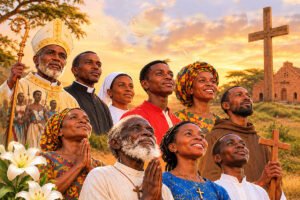
This memory teaches us that the Church transcends the boundaries of the visible world since it unites three realities in the one mystical body of Christ: the Church triumphant, the Church militant and the Church suffering (purgative). Through the commemoration, we activate a spiritual solidarity; that is, we ask for the intercession of those in heaven and we offer our prayers (notably the Mass) for the repose of those who are being purified.
This commemoration launches us into an act of radical hope, because in the face of mourning and human finitude, the Catholic liturgy proclaims the victory of Christ over death. This shows us that the promises of baptism are real. In addition, it reminds us of the words of Christ: “I am the resurrection and the life; whoever believes in me, even if he dies, will live” (Jn 11:25).
The commemoration of the faithful departed serves as a mirror for our own existence: it invites us to remember eternity and helps us to detach our hearts from the ephemeral goods of this world in order to concentrate on what remains: love and charity. This memory facilitates the imitation of the virtues of those who have gone before us, whether a great saint or a close relative who lived humbly; their memory is an encouragement to walk in our turn towards holiness, knowing that our choices today build our destiny tomorrow.
Through this commemoration, we understand that memory is not a sterile and painful nostalgia. It is based on the certainty that those we have loved are alive in God. Prayer for the departed aims at the healing of our own grief by transforming it into a dialogue of faith and softens it with the promise that God will wipe every tear from our eyes (Rev 21:4).
The commemoration of the faithful departed brings to light the great design of God: we are pilgrims on the way towards the heavenly homeland; those who have gone before us and whom we remember today are already waiting for us there.
Give them, Lord, eternal rest, and let eternal light shine upon them. May the souls of all the faithful departed rest in peace, through the mercy of God. Amen.
By: Abuh Anthony Ejeh, M.Afr.